
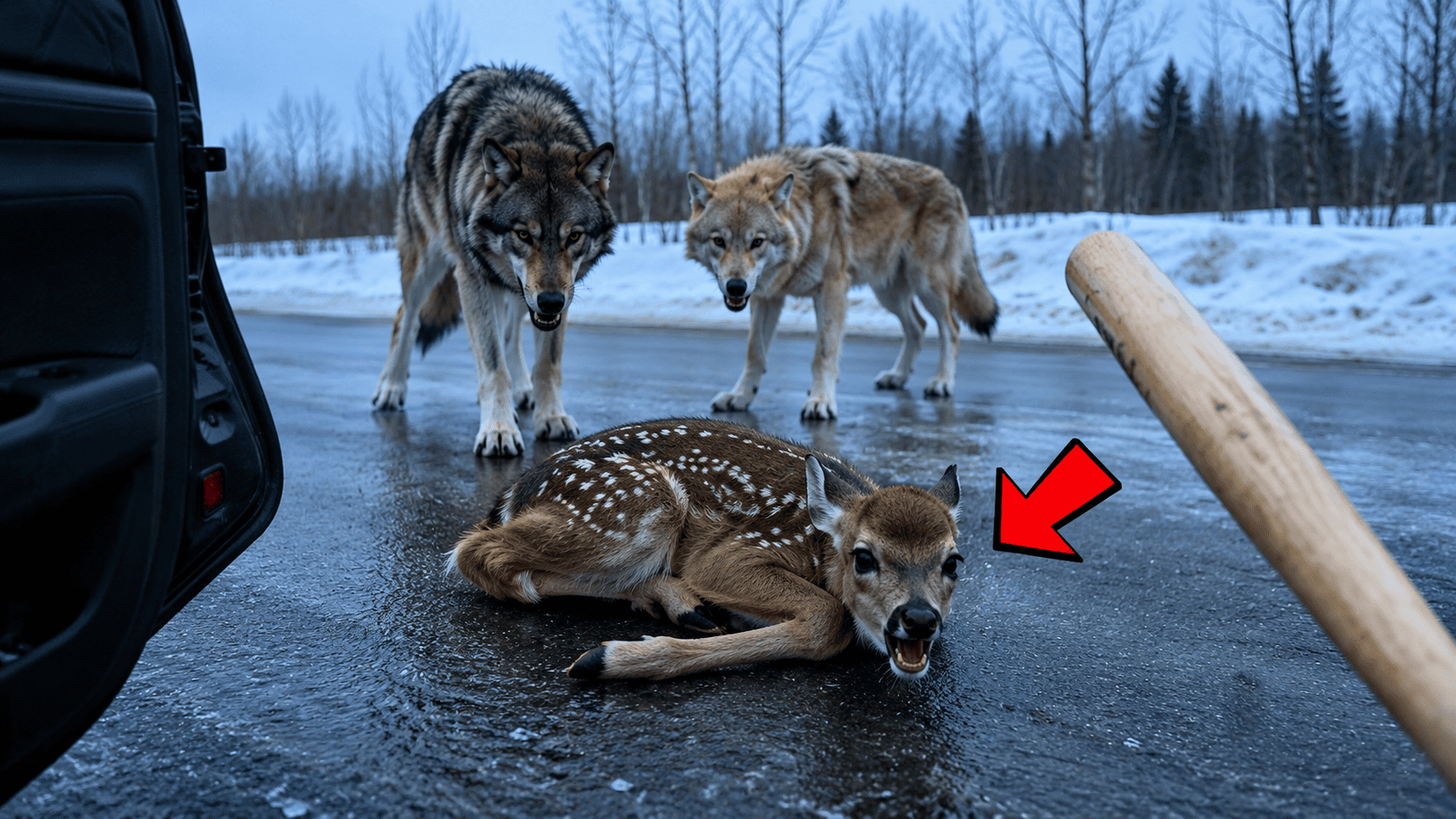
The road was almost empty that morning. What Mark saw ahead of him would force him to make a split-second decision — one that would change everything.
A thin layer of ice covered the asphalt, and the forest on both sides stood silent under the snow. The sky was pale blue, the kind of cold winter light that makes every sound feel sharper than usual. Mark was driving slowly through the back road when something moved ahead of him.
At first, he thought it was a branch sliding across the ice.
Then he heard the cry.
It was high, desperate, and impossible to ignore.
In the middle of the frozen road, a tiny fawn was lying on its side, kicking weakly against the ice. Its mouth was wide open, crying as if it knew there was no way out. Two wolves stood over it. One gray, one pale and almost white against the snow. They were circling, hungry and tense, their heads low, their eyes fixed on the helpless animal.
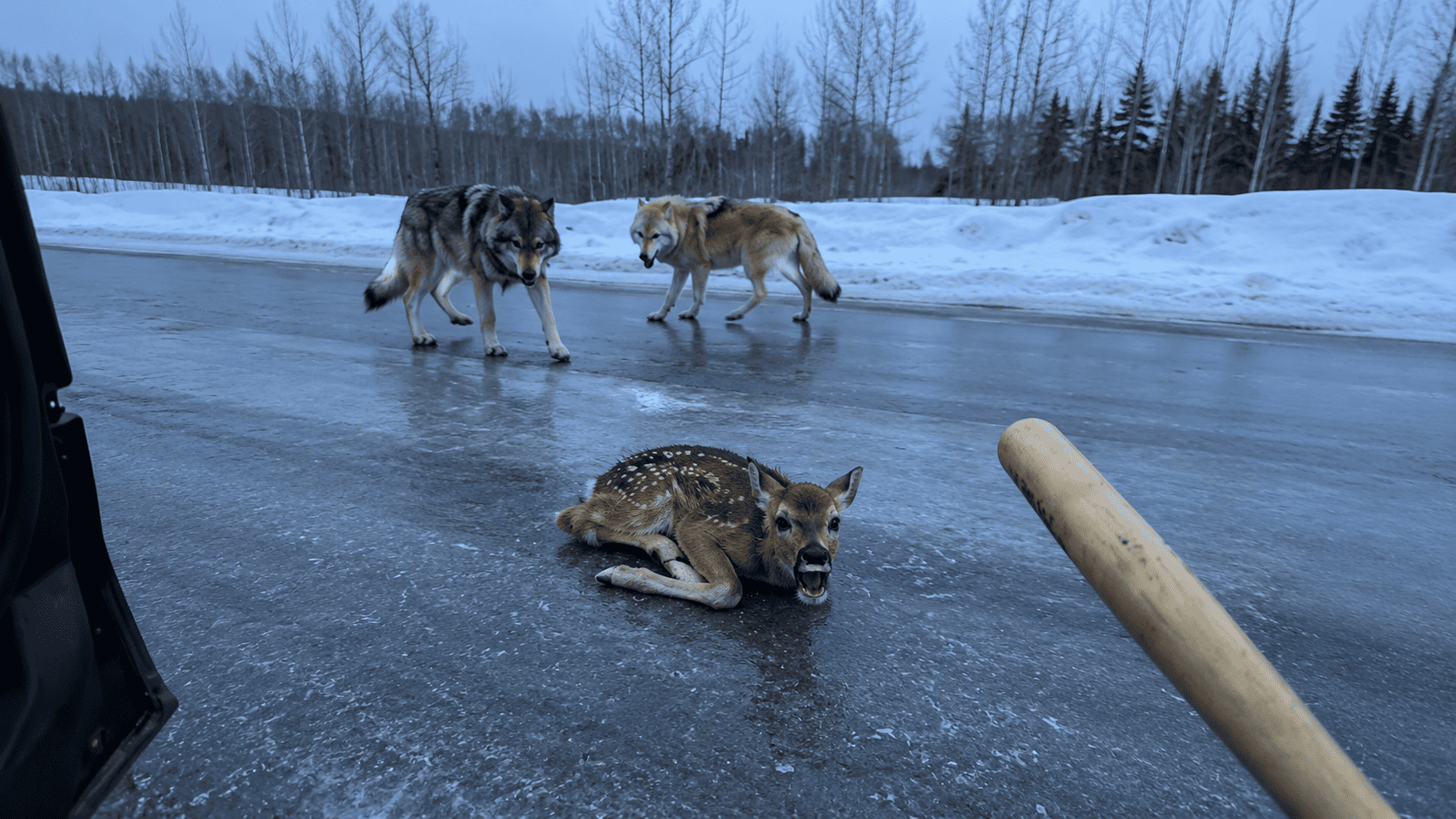
Mark hit the brakes.
For one second, he froze.
Then the fawn screamed again.
He reached across the passenger seat, grabbed the wooden baseball bat he kept in the car, and pushed the door open.
The cold air hit him hard. The wolves turned their heads toward him, but they didn’t run. The gray one stepped sideways, watching him. The pale one lowered its body and growled.
“GO!” Mark shouted. “GET OUT OF HERE!”
His voice cracked through the empty forest.
The fawn kept crying behind them.
Mark stepped forward, his boots sliding slightly on the icy road. He raised the bat and slammed it hard against the frozen ground. The sound snapped through the trees like a gunshot. Both wolves flinched, but still they hesitated.
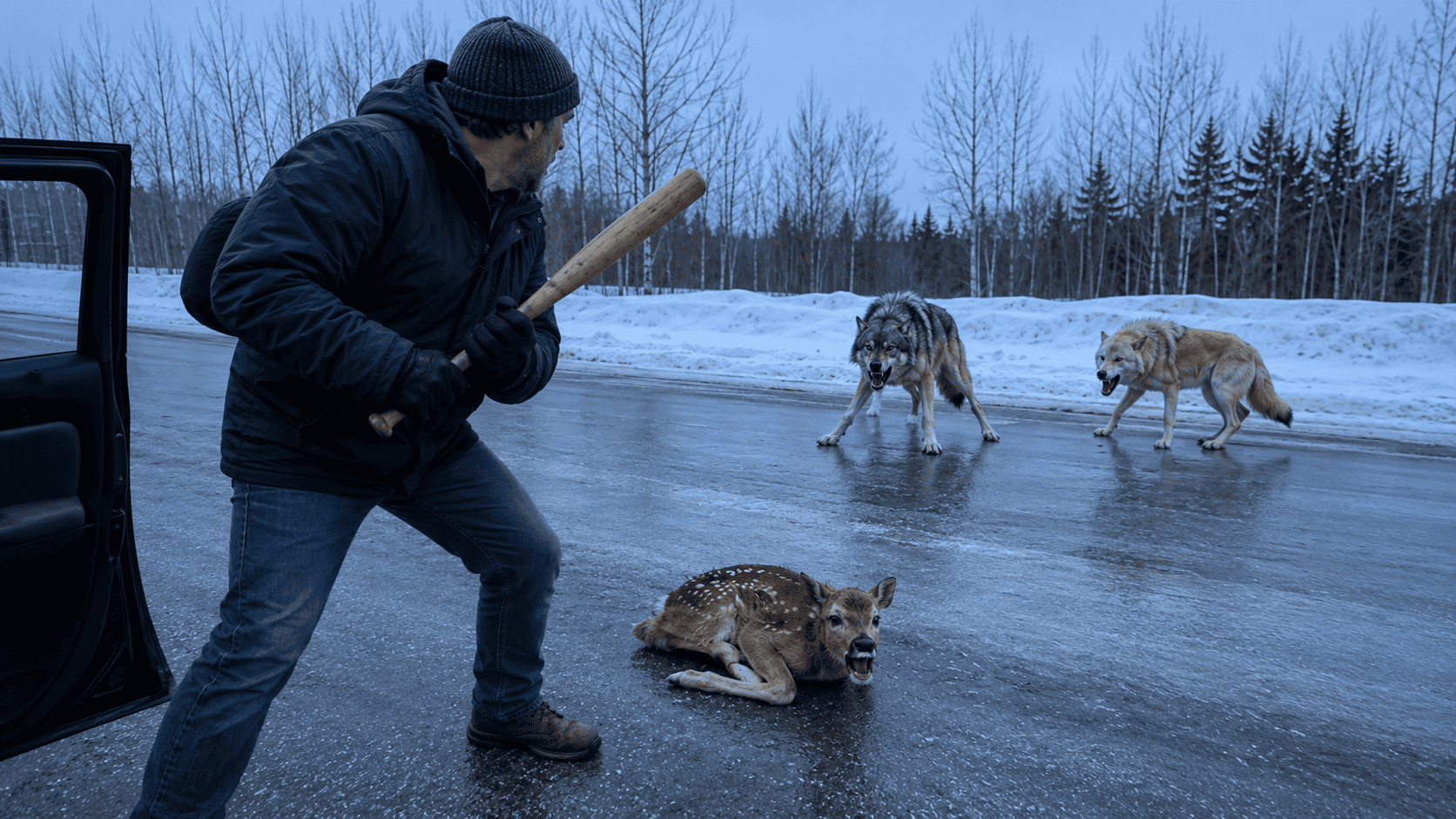
“MOVE!” he yelled again. “GO!”
The gray wolf backed away first. The pale one stayed a few seconds longer, baring its teeth, angry and unwilling to give up its prey. Mark didn’t move closer to hit it. He only made himself bigger, louder, more dangerous.
Finally, the pale wolf turned.
Both animals retreated toward the tree line, stopping once to look back before disappearing between the dark trunks.
Only then did Mark lower the bat.
The road was quiet except for the wind and the weak cries of the fawn.
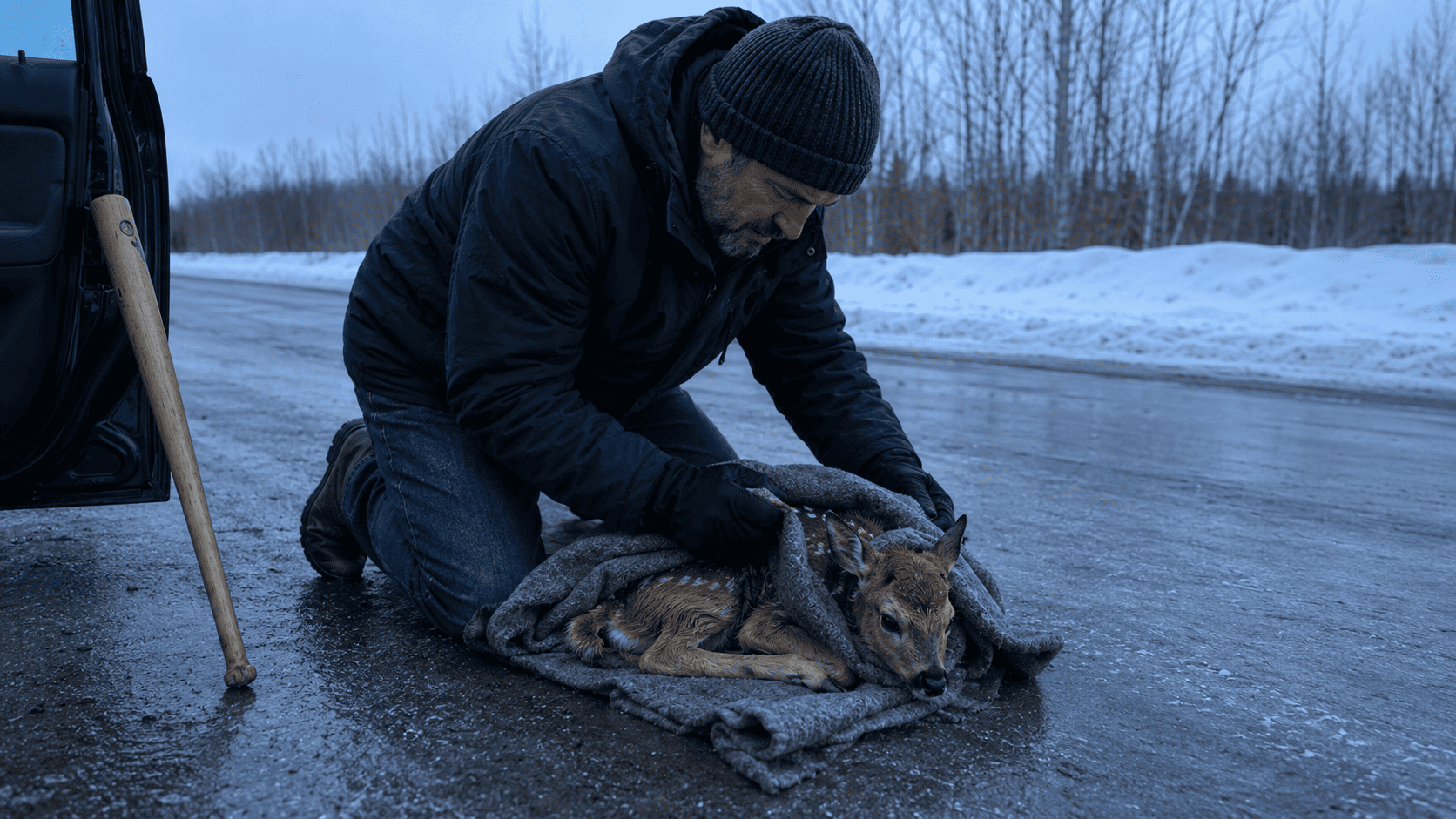
He knelt beside it slowly, careful not to frighten it more. The baby deer was shaking violently. Its legs were thin and stiff from the cold, and its breathing came in quick, shallow bursts. There were marks on its back leg, but it was alive.
“It’s okay,” Mark whispered, his voice completely different now. “I’ve got you.”
He took an old blanket from the back seat and wrapped the fawn as gently as he could. It struggled at first, but it had almost no strength left. Its tiny body trembled against his hands as he lifted it from the ice and placed it carefully inside the car.
Before driving away, Mark looked once more toward the forest.
The wolves were gone.
But somewhere beyond the trees, the fawn’s mother was still out there.
Mark called a local wildlife rehabilitator from the road. By the time he arrived, the fawn was barely moving. The veterinarian checked its body, cleaned the wounds, and treated it for shock and hypothermia. The first night was the hardest. No one knew if the little animal would survive until morning.
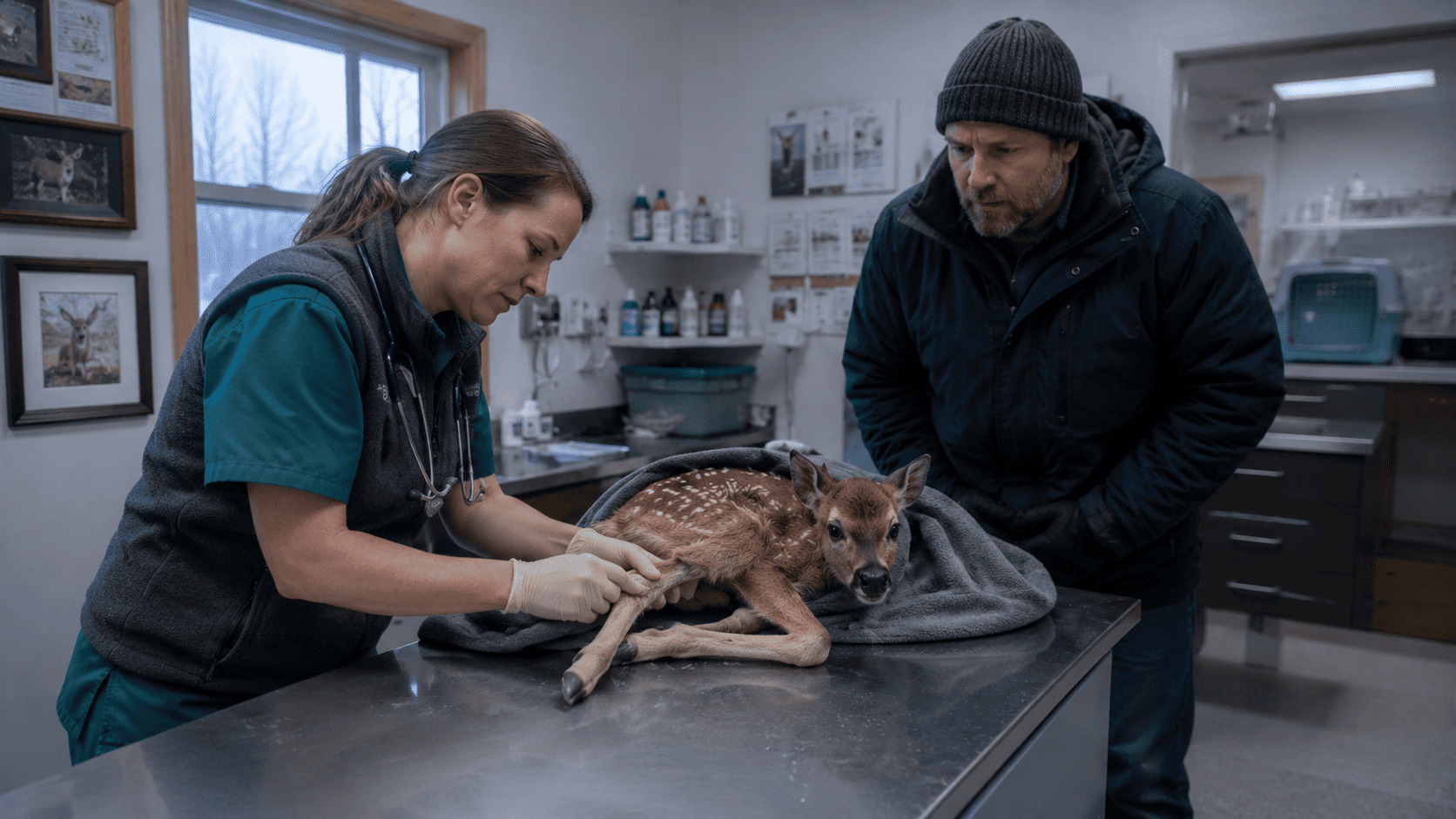
But it did.
The staff named the fawn Willow.
For the first few days, Willow refused to stand. She would only lift her head when someone entered the room. Her eyes were huge and frightened, still carrying the memory of the road, the wolves, and the cold. But little by little, she began to drink. Then she began to eat. Then, one morning, she pushed herself up on her trembling legs.
Everyone in the room stopped to watch.
It was only a few steps.
But it was enough.
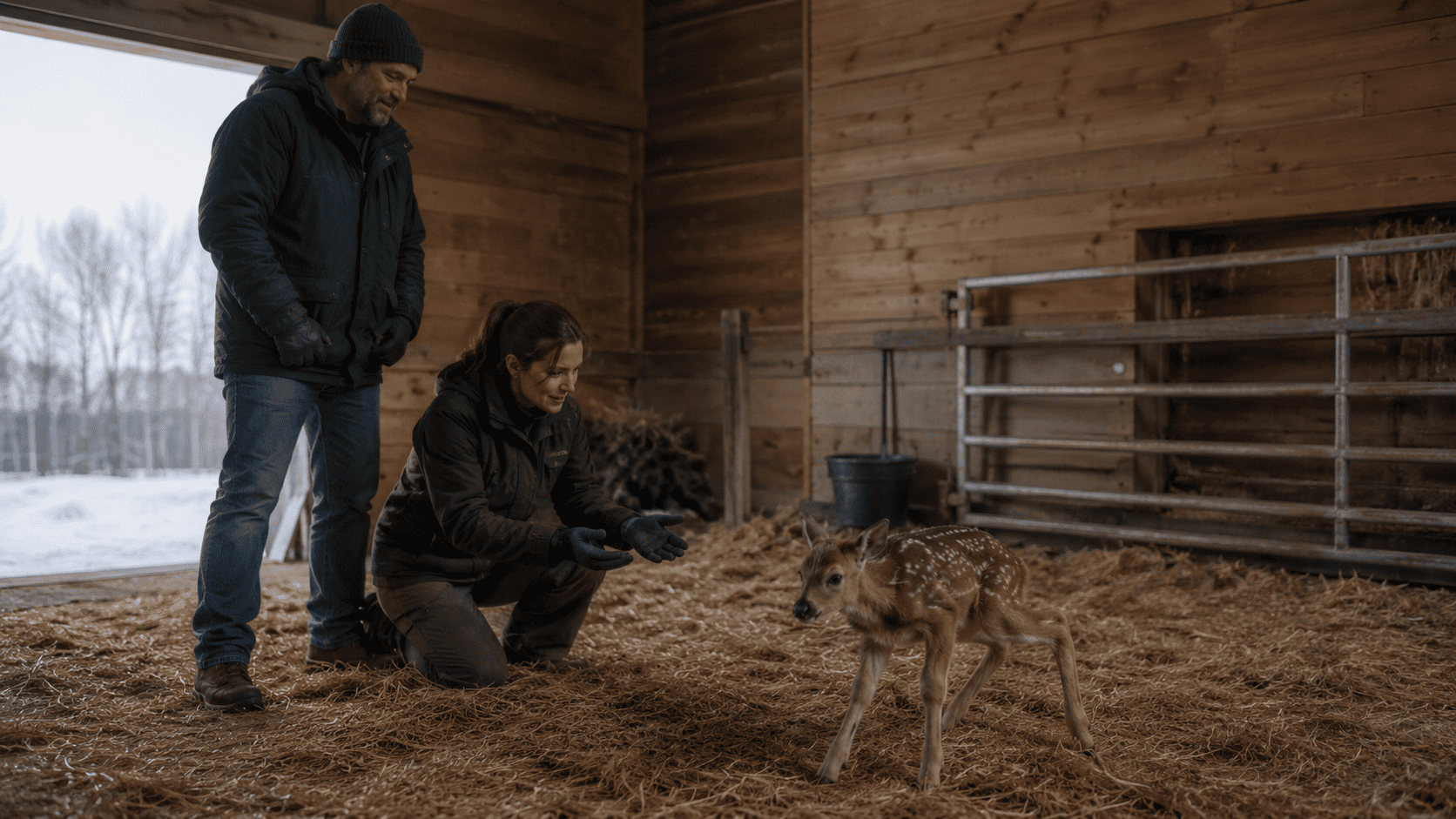
As Willow grew stronger, she was moved to a quiet recovery barn near the edge of the woods. That was where she met Ranger, an old rescue dog who had lived on the property for years. Ranger was calm, gentle, and unusually patient around injured animals.
At first, Willow was scared of him.
But Ranger didn’t chase her. He didn’t bark. He simply lay down a few feet away and waited.
The next day, Willow stepped closer.
A week later, she was sleeping beside him in the straw.
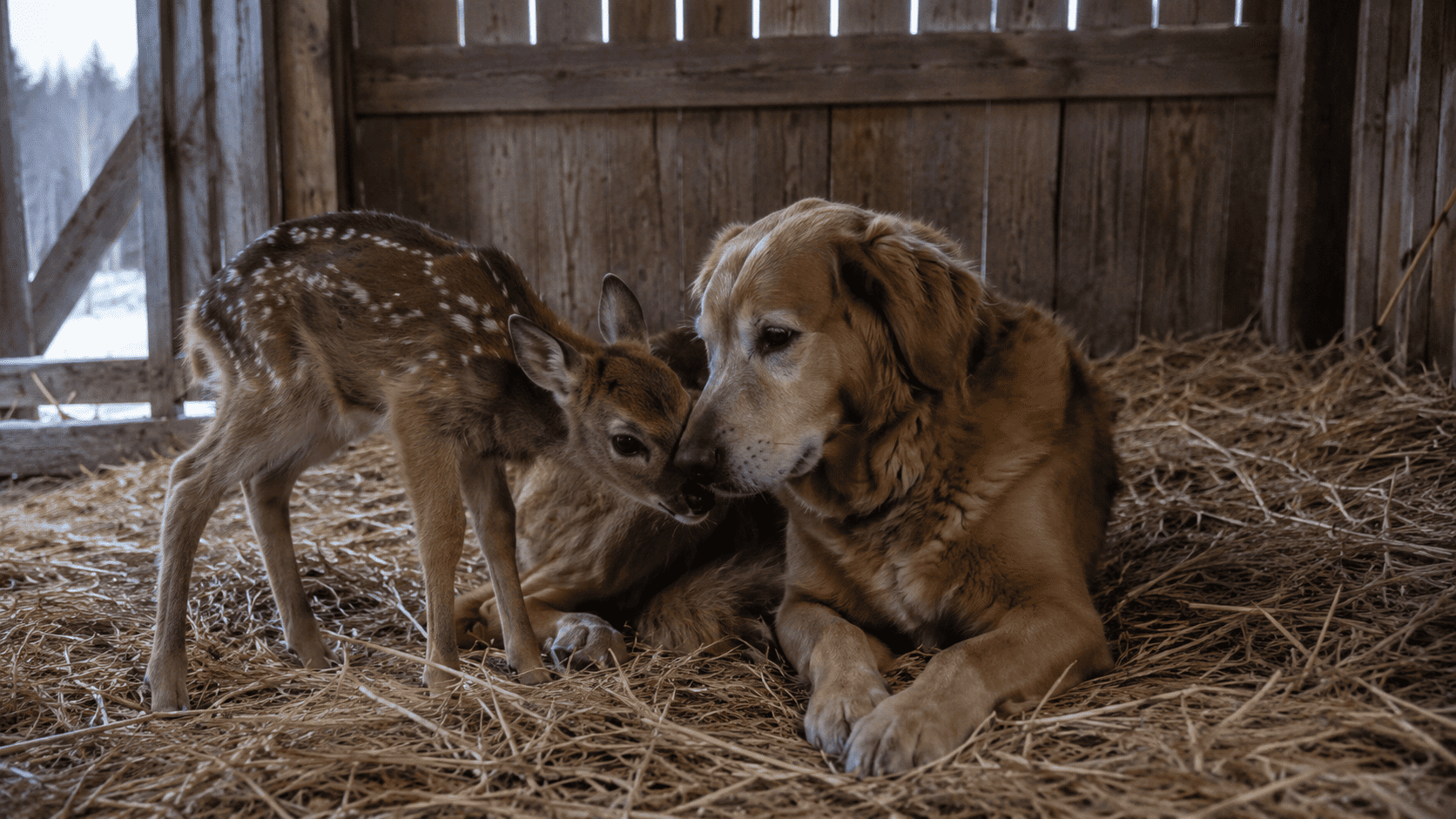
Their friendship became the softest part of her recovery. Ranger watched over her as she learned to walk without limping. He followed her along the fence line. He sat quietly while she ate. And when strange sounds came from the forest, Willow would move closer to him, as if his presence reminded her that she was safe.
But wild animals are not meant to stay forever.
After several weeks, Willow was strong enough to return to the woods. The rehabilitator began leaving her in a larger outdoor enclosure during the day, letting her hear the forest again, smell the trees, and feel the snow under her feet.
Then, one evening, something unexpected happened.
A doe appeared at the edge of the property.
She stood completely still beyond the fence, her body half-hidden between the trees. She didn’t run. She didn’t come closer. She only watched.
Willow lifted her head.
For a long moment, neither animal moved.
Then the fawn made a soft sound.
The doe stepped forward.
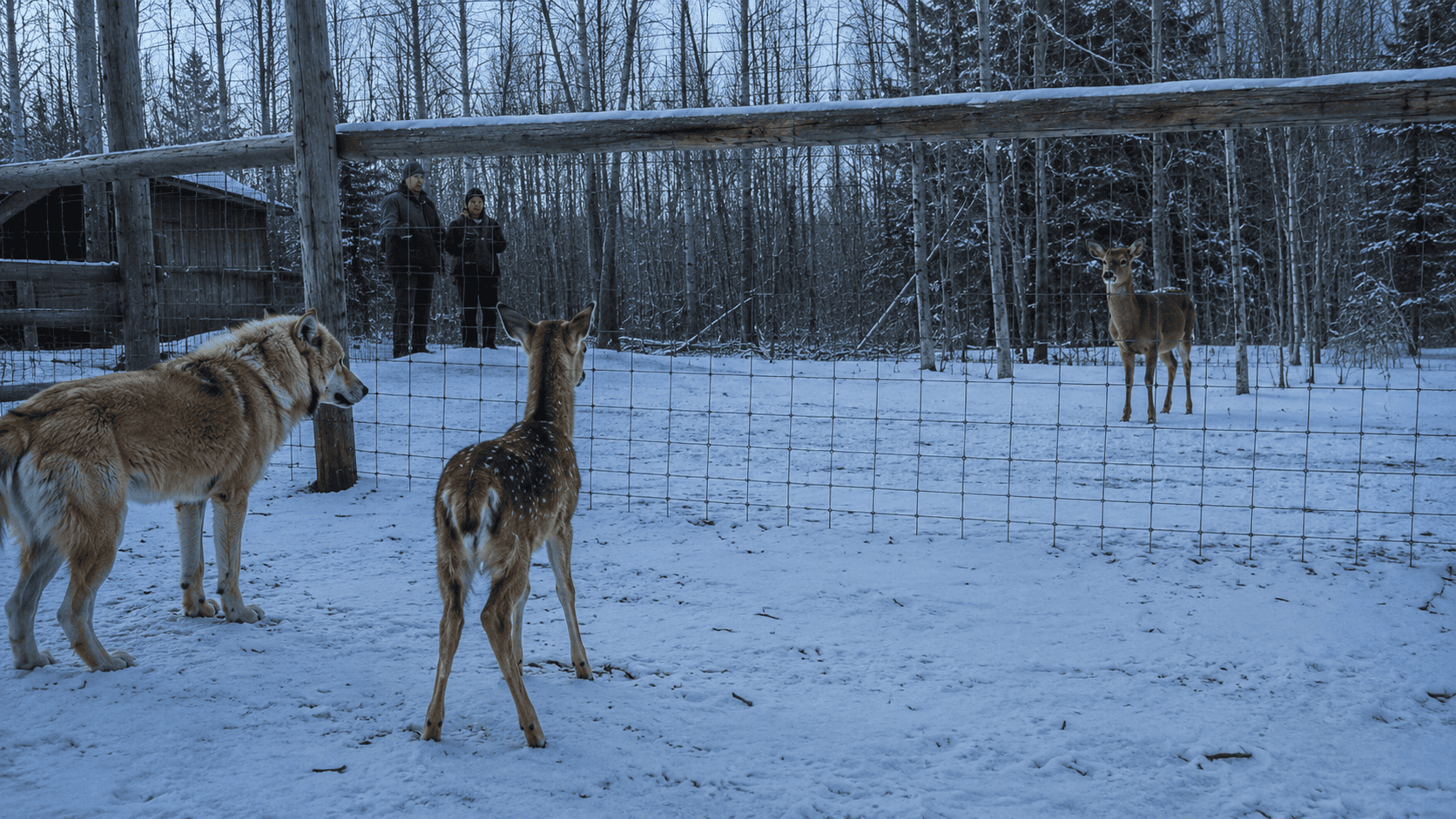
No one could prove it was her mother. But the way Willow reacted made everyone silent. She pressed herself against the fence, ears forward, body trembling with a different kind of emotion now.
Not fear.
Recognition.
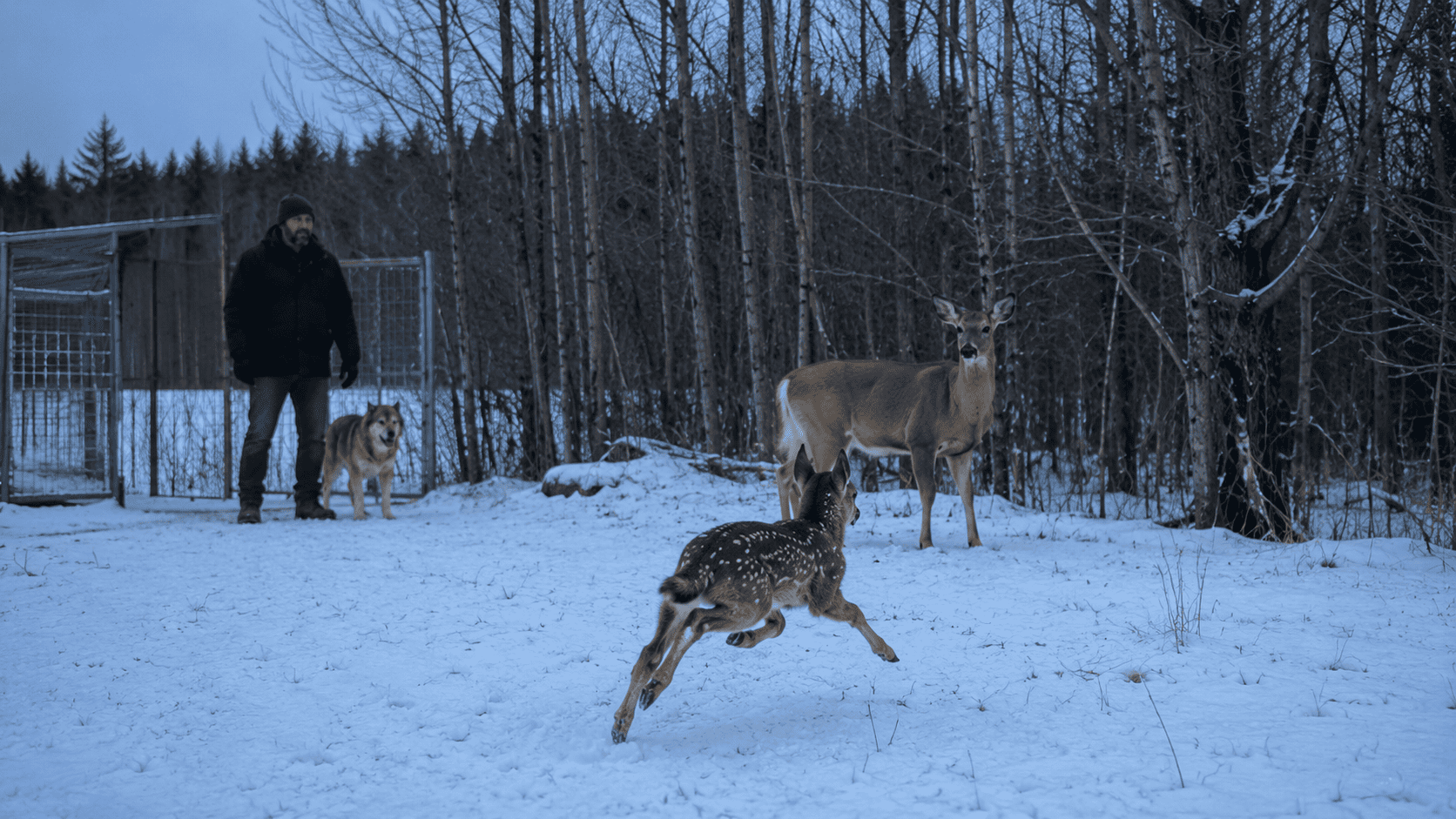
The next morning, the enclosure gate was opened.
Willow hesitated at first. Ranger stood behind her, quiet as always. Mark was there too, standing beside the rehabilitator, watching the little fawn he had pulled from the frozen road.
Willow took one step into the snow.
Then another.
The doe was waiting near the trees.
For a second, Willow looked back. Her eyes passed over the barn, the people, the old dog who had guarded her through the hardest days of her life.
Then she ran.
Not perfectly. Not fast.
But free.
Mark stayed there long after they were gone, listening to the silence return to the road and the trees. He knew the wild would always be dangerous. He knew he might never see Willow again.
But that was the point.
She had not been rescued so she could belong to him.
She had been rescued so she could go home.
Leave a Reply